Mais um excelente artigo do Martin Goldberg publicado no site Financial Sense.
"Corollary to the Peter Lynch Principle – Only Buy If You Can Explain a Big Loss to Your Wife" And, “There’s Always a Bull Market Somewhere”
With the market showing no signs of falling or even correcting in a meaningful way, it looks and feels like 1999 again. For those brave enough to have ignored general market fundamentals and intelligent enough to have bought technology and other speculative stocks based mainly on the short term technical charts, now is the time to enjoy the ride (with logically placed stop orders), assured that you are playing with the “house money”. Those investors who did not ignore fundamentals may feel left out in the cold. In my view, it would probably be wise to enjoy the technology mania show from the sidelines, and focus on the small and narrow pockets of the stock market where there still are fundamental reasons to buy. In this article, I will take a look at a stock market example that suggests that in some important ways, the current mania is well beyond the one that lasted through the 90’s until March of 2000. I will also take a technical look at a relatively small stock market sector where there is a real bull market occurring.
In his book, One Up On Wall Street, Peter Lynch describes some simple strategies to stock picking that can be used by people investing their own money. Lynch suggests that investors consider buying stocks where they could explain to an 8-year old why they think the stock is a good investment. For example, if the “Limited Too” clothing store was packed with customers, you could easily explain to your 8-year-old why buying the stock may be a good idea. Using similar reasoning, if the local “Toys Are Us” store is disheveled and not crowded during the Christmas season, it may also be easy to explain to the same 8-year old why you think shorting the stock is a good idea. I agree with the Peter Lynch principle although I think that people are going to get burned badly in some cases where the fundamentals and valuation of the company are not also considered. For example, it is clear to my 8-year-old daughter Linda and me that the Amazon.com web site is a real cool way to shop for and buy books and other things. (However, we have also found that with a broadband connection, it’s also a lot easier to shop around.) But I also think that people betting that Amazon will be a good long-term investment at today’s prices are forgetting another parental principle that my wife and me have taught our two daughters: “It’s OK to make mistakes (everyone does). But it’s not OK to keep making the same mistakes over and over.” Today’s stock market traders, again smitten with speculation, are clearly making the same mistake that they made just a few short years ago.
Below is a long-term chart of Amazon.com (AMZN). The following analysis is less about Amazon.com and more about how we are at a higher level of speculation in many respects now compared to the March of 2000 technology top.
As you can see, current “investors” are betting that Amazon.com will climb the same mania ladder that it briefly climbed in the winter of ’99-’00. Can it happen again? I suppose that anything is possible in today’s market. Reality and the chart above however, clearly suggest that in many ways, today’s mania is more illogical than at the ‘99-00 bubble. Why? In the late ‘90s, Amazon.com was still an unknown business. There was hope that they would build an impenetrable franchise and grow from that point, while expanding their margins. At that time, I’m sure that many institutional investors would have suggested that by 2004, Amazon would be able to post some significant and consistent profit by now. Yet in retrospect, they have failed so far. However, what has become apparent is that Amazon is a retail business with many of the characteristics of every other retail business. It is subject to competition, and has high cost of sales including the need to advertise in old economy venues like magazines, and pay for shipping. Broadband connections, once thought to be an advantage to Amazon, have become a double-edged sword. Now at practically the blink of an eye, shoppers can move from Amazon.com to Walmart.com, Buy.com, Sears.com, Overstocks.com, Barnes and Noble.com, or Anyretailer.com. Will Amazon.com become a successful and profitable company after they pay off all of their debt? May be. Will Amazon.com conquer the world of retail? Not a chance - there is too much competition, and the last 5-years have shown us that the competition will not go away. Amazon’s margins will constantly be compressed by price comparisons, and Amazon will never get enough leverage to expand their margins from the supply side. Is the Amazon.com business actually worth the same amount as the sum of Barnes and Noble (BKS), Borders (BGP), Sears (S), and JC Penny (JCP), even though its current sales are only 1/9th that of Sears? That’s how it is valued in today’s market. In the beginning of 1999, with Amazon at only one-half its current market cap, there were a lot of unknowns about the Amazon.com business. Now, the unknowns have become known, and yet Amazon trades (again) as if it were the “thing of the future”. Finally, the sales tax issue is out there for resolution. It amazes me how customers must pay state sales tax at Wal-mart.com, and other on-line retailers, and do not at Amazon.com. With state governments strapped for cash, I wonder how long that is going to last. My suspicion is that it will only last until shortly after presidential Election Day.
So, a stock that is overpriced and peppered with potential problems such as Amazon is probably a good company to short, right? Definitely not. Amazon is still an institutional favorite. It meets the Peter Lynch principle and in this market mania, there is no reason to believe that it won’t go higher. I’d bet a lunch that the upcoming earnings report will be full of happy talk and “special” things that will be ignored or cheered by partying Wall Street.
If you think it may go higher, why aren’t you buying it? Because it does not meet the “Spousal Corollary” to the Peter Lynch Principle which I will describe below:
Spousal Corollary to the Peter Lynch Principle – “Only buy stocks that you can explain to your wife (or husband) why you took a big loss.”
If I were to buy Amazon and lose money on it, I would have a lot of explaining to do! A good explanation would have to include something more fundamental and logical than the technical chart, and telling my wife that “Amazon was going up!” By the same logic, shorting Amazon would not be a good idea either. Losing money by shorting internet stocks is not a good way to solidify any marriage. There is simply too much risk.
There’s Always a Bull Market Somewhere – Keeping Your Eye on the Ball
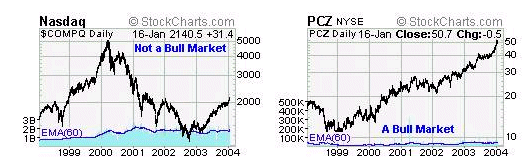
The re-inflation of the technology stock market bubble has caused many people to forget that there is always a real bull market somewhere. The magnitude and duration of the insanity in technology, semiconductors, and Internet stocks have put them back on center stage of many people’s attention. As a result, many investors have been distracted away from the fact that there is always a bull market somewhere. Let us look below at two long-term examples of what is a bull market and what is not a bull market.
It’s apparent that investing in most NASDAQ stocks is purely gambling. This is illustrated by taking the long view of the chart that includes a tremendous bubble parabolic bubble peak. Note that the P/E of most large NASDAQ technology stocks is still generally over 40. Stocks such as Amazon and Yahoo routinely have triple-digit P/Es, and of course, no dividends. Most technology stocks have just shown us over the last 3 years that their prospects are tied directly to the economy. They are just companies like every other. A fast economy equals growth such as the “whopping” 6.5% year over year sales growth for Cisco. A slow economy will equal sales shrinkage. So why do companies such as these trade at such high valuations even in the best of times? Beats me. Better ask your fund manager!
The chart on the right is a long-term chart of Petro-Canada (PCZ). This chart is typical of the large cap Canadian oil and gas sector. These stocks currently trade at single-digit to low double digit P/Es, and will benefit from the strong Canadian dollar, and the bull market in “real things” that are discussed elsewhere on the FSO site (see the FSO home page).
Similarly the Canadian Oil and Gas sector would seem to adhere to the Spousal Corollary to the Peter Lynch principle. It would be easy for me to explain why a big loss was taken on a Canadian oil company. The logic behind their purchase is clear – they produce a real and valuable commodity at a reasonable valuation.
Although they are also in a bull market, a 20% loss on a gold mining stock may be much more difficult to explain because gold mining seems speculative to a layman or spouse not interested in the stock market.
O Clubeinvest.com informa que nenhuma da informação
aqui facultada deverá ser entendida como conselho ou recomendação
de qualquer tipo de transacção ou investimento.