That some will read a discussion of inflation rather than watching world events on television is a rather high expectation. Pulling away from watching is hard to do. But, despite all the technology being applied in Iraq one thing still stands out. After all the cruise missiles and guided bombs, war still requires a foot soldier in the dirt to finish the task. The foot soldier is still the fundamental and critical means of extending military power. And just as the foot soldier continues to study and work on the basics so must the wise investor.
Two reasons exist for these comments at this time. First, you still have to guide your investments. On Monday we again learned that the "canned" solutions of the cable gurus is less that helpful. As a consequence, Gold is providing an excellent buying opportunity. Second, the Battle of Iraq is simply a part of a greater war, the Pan-Eurasian Islamic War. And War adds to inflation. The end of War reduces inflation. Since the end of the War is a long way off investors must have a firm handle on the inflationary tendencies around them. Gold again is an appropriate investment idea in such a situation.
The fixation on deflation, the contra to inflation, continues somewhat widespread. Encouraged by some analysts, this fixation in part is due to the sad state of the equity markets. Confusing deflation with a bear market seems to be a common error. Collapsing wages for analysts and investment bankers is not deflation, just justice. Stock prices going down are not a sign of deflation, but rather the fairly telltale tracks of a Bear market.
In simplest terms, inflation is a purely monetary phenomenon. Inflation is the rate of increase in the supply of a country's money supply. Unless offset by other factors, the purchasing power of money will fall by the amount this money supply increases. Prices, in terms of this money, should rise by the amount of increase in the money supply. Likewise, deflation is a purely monetary phenomenon. Deflation is the rate of decrease in the supply of a country's money. Unless offset by other factors, the purchasing power of money will rise by the amount this money supply decreases. Prices, in terms of this money, should fall by the amount of decrease in the money supply.
Let us though describe some additional conditions. "Rising prices" is a condition where prices are rising in a given market for a good or service due to factors other than an increase in the quantity of money. "Declining prices" is a condition where prices are falling in a given market for a good or service due to factors other than a decrease in the quantity of money. These conditions, rising or falling prices for a particular product, can always exist along with either of the general conditions of national price trends, inflation or deflation.
National productivity, a measure made popular by the Federal Reserve during the Era of Economic Delusion, may not have any impact on inflation or deflation. Productivity may have an impact on the rate of change and the direction of movement for prices in a given market. In short, the Federal Reserve has treated productivity as if it were always a macroeconomic factor rather than perhaps a microeconomic event. Using macroeconomic measures, like GDP, to deduce a national rate of productivity presumes that what might be industry or product specific events can be somehow summed, or aggregated.
Perhaps some examples of the problem might be helpful. Suppose you are a plumber, working hard and charging about the same as a neurosurgeon. Your daughter convinces you to buy a new computer and a state of the art accounting software package. This new system allows you to do all your bookkeeping on one Saturday each month rather than spending every Saturday doing so. You are now more productive, generating the same amount of revenues but working three days less a month. Our plumber might now have time for fishing, but more than likely will find himself driving a daughter to soccer games.
Is the plumber going to lower prices? My guess is probably not. However, when the government calculates national productivity it concludes that the productivity of the nation has gone up. Our plumber's purchase of a computer is somehow now a "productivity miracle." Will prices anywhere in the economy go down because our plumber is more productive? No. However, the Federal Reserve might use this productivity miracle as a rationale to print money.
The Federal Reserve, elated over the emergence of a productivity miracle, lowers interest rates by creating money. Other prices will rise due to all this new money. Feeling the effect of rising prices all about him, our plumber responds by raising prices. So rather than lowering prices the productivity miracle, if it ever existed, is used as a rationale for inflationary policy.
Among the arguments sometimes put forth by the deflationists is China. China produces a vast number of products at lower prices due to having a vast underutilized labor force. Low prices for Chinese goods are not an indication of deflation, but simply the manifestation of price competition. If the U.S. dollar were not depreciating the prices of imported goods might even be lower.
And as we will talk in a moment, shifting currency values can cause the price of imported goods such as those from China to rise. The export price of a Chinese laptop computer, in Chinese money, is the same for a North American as it is for an Argentinian. However, the currency of Argentina was devalued by the market. As a consequence the price of the Chinese computer in Argentina exploded.
Domestic consumers, just like those in Argentina, must pay for goods with their domestic currencies. If the exchange rate for their currency depreciates 25%, then the domestic prices of imported goods should rise by 25%, all else unchanged. While credit may be contracting in any particular economy suggesting deflation, the devaluation of the currency will cause prices to rise and real incomes to collapse.
If the exchange rate for a currency depreciates 25%,
then the domestic prices of imported goods should rise by 25%.
The debt bubble is perhaps the major argument put forth by the deflationists. Here again we find a failure to include the role of currencies in the aftermath of the implosion of the U.S. debt bubble. That the U.S. is involved in multiple debt bubbles is not disputed. That these debt bubbles will pop is also not a matter to argue. The consequences of the debt bubble are the issue.
Two debt bubbles are being created. One is the Greenspan Mortgage Bubble that will ultimately pop and decimate the value of U.S. housing and financial traumatize the holders of mortgage debt. Those owning bond mutual funds holding the debt related to housing will soon discover the meaning of the word "gigantic" when used with the word "loss." The second bubble is the massive holdings of U.S. debt by foreign investors, particularly central banks.
As of the last report, foreign central banks owned $900 billion of U.S. government debt. That ownership has increased by $155 billion in the past year. The U.S. is utilizing foreign investors to finance both the current account deficit and the Federal deficit of the country. This debt exposure is what puts the U.S. in a situation that will lead to an explosion of inflation in the U.S.
When, not if, foreign investors lose their appetite for U.S. debt is the concern. First, they will cease buying the debt. As the losses mount on these holdings they will start selling these bonds. Ultimately the selling of U.S. debt will lead to a 40-60% devaluation of the U.S. dollar. The situation faced by the U.S. is similar to that of Russia and Argentina where devaluation and inflation were the consequences. A comparison to the Japanese situation in this case is faulty as Japan runs a trade surplus and does not rely on foreign investors for financing. Deflation of the Japanese type is not likely in the U.S.
Exploring misconceptions about inflation like those above is important. An equally relevant matter for investors relates to the measurement of inflation. Many realize that the measures of inflation that are produced by the government may be less than perfect, and indeed might in some case border on an attempt to mislead. The CPI, perhaps the most popular measure, is less than desirably constructed, and may exist in its current form only to hold down the annual increases in Social Security payments.
What may be baffling to some is the large number of inflation measures that exist. If your read carefully the articles recounting the opinion of policy makers note the number of measures used. They may talk about "inflation," but they really only mean that inflation measure which is their favorite. We have measures that exclude food and energy, cause the prices of these goods do not matter. Other measures change the composition of the basket of goods, always increasing the exposure to those goods with the lowest prices. In a recent article recounting the opinions of makers of monetary policy about four different measures were cited. Next time you read such an article try to determine what measure of inflation is being discussed, and how many different ones are mentioned.
What really makes all these issues pertaining to inflation important to investors is that the Federal Reserve uses these measures to make policy. If one measure does not agree with their opinion, they may simply change measures. Prices may be going out of control in some sector but since the CPI is not influenced by these price dislocations they are ignored. Such was the case with policy that gave us the greatest stock market bubble in history and is now creating a giant mortgage bubble. Simply remember that what inflation is actually doing matters little. What matters is the action of the measuring indicator that is being used by policy makers.
The inappropriate use of these measures by the Federal Reserve distorts the performance of markets and creates bubbles. For example, over the past year the CPI has risen 3.0% and the CPI less food and energy has increased 1.9%. The Prime Rate is 4.25%. Using the first measure the real rate of interest, nominal rate of interest minus inflation, is a positive 1.25%. On the latter measure the real rate of interest is a positive 2.35%. To many in the economic community these measures suggest that interest rates are too high. Rates should be lower according to them. That view prevails even though the excessive credit being created to keep interest rates abnormally low is fueling the Housing/Mortgage Bubble.
Policy makers however continue to focus on the bear market in stocks. Believing that only by turning the stock market through excessive credit creation can they save the U.S. economy. Rather than saving the U.S. stock market and economy, the Federal Reserve is inflating another financial bubble and setting the stage for a massive devaluation of the U.S. dollar. The Federal Reserve continues an approach that uses financial bubbles to maintain the economy.
Today's policy is similar to the rationale used to create the stock market bubble. While the CPI was moving up modestly the Federal Reserve provided bountiful credit that spilled over into the stock market. A bubble was created and burst. Now again the Federal Reserve is making the same mistake. The 30 year fixed rate mortgage is 5.6%. Based on Freddie Mac data, housing prices during the past year have risen about 6.6%. With "housing inflation" running at 6.6% and the nominal interest rate at 5.6%, the real rate of interest in the housing market is a negative 1%. Borrowers have been getting a free ride in this market. Such is the reason a bubble exists in the housing market.
The reasons we dwell on such matters rather than moving on is that should anything cause these inflation measures to move higher the Federal Reserve will likely respond. A higher rate of reported inflation by government measures would put pressure on the Federal Reserve to raise interest rates. Or the depreciation of the dollar may simply force the matter, and the markets will raise interest rates. And should the rate of interest rise, the proverbial rug will be pulled out from under the Housing/Mortgage Bubble with dire consequences for the U.S. economy. As the housing/mortgage bubble implodes so will the economy, and the value of the U.S. dollar will follow it in abyss.
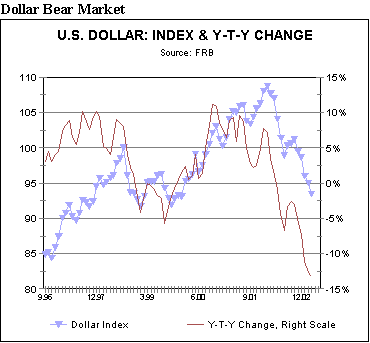
Now, the issue we are really concerned with is the role currency values play in this whole matter. Some may argue the state of the U.S. dollar, but a cursory review of a chart of the dollar's value suggests a bear market operative. The chart, Dollar Bear Market, does show the collapsing momentum of the U.S. dollar. The thin line is the year-to-year change of the Fed's dollar index and uses the right scale. Momentum has broken down, and the index is now about where it was at the end of 1997. All of the dollar's appreciation falsely created by the Greenspan Financial Bubble has now dissipated.
We do have to buy foreign goods as the Federal Reserve policies have essentially driven so many U.S. manufacturers out of business. The False Financial Bubbles created an over valued dollars as foreign investors chased the easy money to be made in U.S. financial markets. Manufacturing that had not already been moving overseas was forced into doing so by the over valued dollar.
As we write, only about 75% of U.S. manufacturing capacity is operating. No wonder the productivity numbers seem better, all the work is being done in other countries. The only work practically left to be done is to order those goods over the internet from a foreign manufacturer. Greenspan's productivity miracle is really not much more that moving all the jobs to other countries.
A rising dollar made imported goods cheaper for U.S. consumers. Those cheaper prices depressed the prices at which U.S. manufacturers could sell goods. As the dollar falls in value, the price of imported goods can rise. This upward movement of import prices also raises the price at which U.S. manufacturers can sell goods. A declining value of the dollar raises the pricing umbrella for U.S. producers, giving a further boost to inflation.
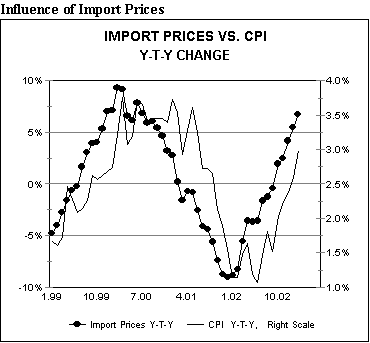
In the graph, Influence of Import Prices, is shown the year-to-year change in the index of import prices and the consumer price index. Please note that import prices use the left scale and the CPI uses the right axis. Immediately one observes the close correlation between the movement in these two measures.
In the period of time shown, when the rate of change of import prices was rising the rate of inflation, as measured by the CPI, was also rising. And conversely, when the rate of change of import prices was decelerating the rate of U.S. inflation, again measured by the CPI, also declined. Domestic price inflation has been strongly influenced by import prices.
Another message comes from that graph. The extremely strong correlation between these series, as well as a clear cause and effect, suggests that the value of the dollar has been the dominant force in the determination of U.S. inflation, as measured by the CPI. From this graph we would have to conclude that the notion that the Federal Reserve has somehow controlled inflation is utter nonsense.
Finally on this graph, notice the developments for the most recent periods. Import prices have risen dramatically and are leading domestic inflation higher. While oil prices might weaken after the Battle of Iraq, the bear market for the dollar has only just begun. With the risk of the dollar being devalued by 40-60%, import prices are going to move dramatically higher. An accelerating rate of increase for import price rises can only lead to higher domestic price inflation.
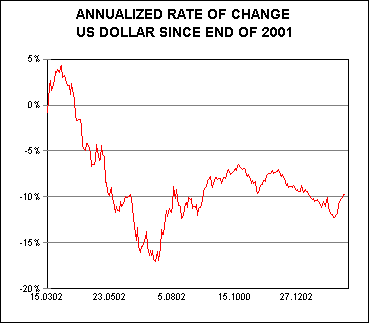
In the final graph is shown the ongoing devaluation of the U.S. dollar by the global markets. The U.S. dollar is devaluing at about a 10% annual rate. As a consequence the cost, or price, of foreign goods should be rising at about that same rate. Deflation is certainly not likely in this case.
Currency values are extremely important when assessing the future of domestic inflation. Leaving the trend of the dollar's value out of any assessment of the future rate of inflation ignores a major determinant of domestic prices. With the U.S. having a trade deficit over $450 billion the influence of import prices may dominate all other considerations.
Given the bear market for the U.S. dollar and likely serious devaluation ahead, expecting deflation in the U.S. simply ignores the role of currencies. U.S. inflation is likely to be currency induced in the years ahead. Interest rates, either due to market action or reaction by the Federal Reserve, will move dramatically higher. The pump for the Housing/Mortgage Bubble will disconnect, and the bubble will implode. The second down leg in the Great Greenspan Mega-Recession is now only a matter of time rather than if.
And let us remember why Gold investors care about inflation. Inflation, as we defined it, is an increase in the money supply of a nation. That condition raises the value of Gold in terms of that currency. That raises the potential for Gold's price to rise in terms of that currency.
Devaluation is the abrupt recognition by the markets of excessive money creation by a nation. That devaluation is reflected in the price of Gold. When the supply of a currency created by the central bank exceeds that which world investors want to hold, the currency will depreciate and Gold will appreciate. Really nothing magically occurs for the dollar price of a Gold is really no more than the reciprocal of the Gold price of a dollar.
What causes Gold's price to reflect its value is shifting money flows in the world. Quite frankly, the world is up to its proverbial "eye balls" in dollars. The world really does not need or want any more dollars. And when they hold those dollars the return is paltry. The choices for foreign investors stuck with dollars is to lose money in the U.S. stock market or earn the paltry yield on Treasury bonds.
In a world with all the U.S. dollars it needs, wants or can stand, the continued "printing of dollars" by the Federal Reserve can only lead to dollar devaluation and Gold's appreciation. The wisest strategy is to move into Gold to protect your wealth from dollar devaluation and inflation. With that strategy in mind we must then look for times when tactical purchases are the most timely.
Investors last week generally concluded that the Battle of Iraq would be over in "a New York minute." Such was the thinking that drove the equity markets into a frenzy in the week ending 21 March, and sent Gold down sharply. Into these moment of irrational optimism on the part of Wall and Bay Street, investors must step in and buy Gold. Gold bottomed almost four years ago! The deflationists have mislead investors the entire time, and will continue to be a source of misdirection. And to all that we have discussed the inflationary impact of war must be added. This Gold Super Cycle is still in puberty, and the next $100 move is up!
O Clubeinvest.com informa que nenhuma da informação
aqui facultada deverá ser entendida como conselho ou recomendação
de qualquer tipo de transacção ou investimento.