Mais um excelente artigo publicado no site FinancialSense desta vez pelo Martin Goldberg.
"Is the Economy Fundamentally Sound?
'Yes' Say the Esteemed and Highly-Regarded Experts""
“…it would probably be unwise to expose the economy to the shock of another major speculative crash. Some of the new reinforcements might buckle. Instead of the investment trusts now we have mutual funds and the contraction here would be sharp. Fissures might open at other new and perhaps unexpected places. Even the quick withdrawal from the economy of the spending that comes from stock market gains might be damaging. Any collapse, even through the further consequences were small, would not be good for the public reputation of Wall Street.
Wall Street in recent times has become, as a learned phrase has it, very “public relations conscious.” Since a speculative collapse can only follow a speculative boom, one might expect that Wall Street would lay a heavy hand on any resurgence of speculation. The Federal Reserve would be asked by bankers and brokers to lift margins to the limit; it would be warned to enforce the requirement sternly against those who might try to borrow on their own socks and bonds in order to buy more of them. The public would be warned sharply and often of the risks inherent in buying stocks for the rise. Those who persisted, nonetheless, would have no one to blame but themselves. The position of the Stock Exchange, its members, the banks, and the financial community in general would be perfectly clear and well protected in the event of a further collapse as sound public relations allow.
As noted, all this might logically be expected. It will not come to pass. This is not because the instinct for self-preservation in Wall Street is poorly developed. On the contrary, it is probably normal and may be above. But now, as throughout history, financial capacity and political perspicacity are inversely correlated. Long-run salvation by men of business has never been highly regarded if it means disturbance of orderly life and convenience in the present. So inaction will be advocated in the present even though it means deep trouble in the future. Here, at least equally with communism, lies the threat to capitalism. It is what causes men who know that things are going quite wrong to say that things are fundamentally sound.” - John Kenneth Galbraith, The Great Crash 1929. (Written in 1954)
There is a wealth of timely and relevant wisdom in the last few paragraphs of Galbraith’s book, which I have quoted above. I recommend that you reread and contemplate his words. Wall Street’s sacrifice of long-term “salvation by men of business” in favor of “orderly life and convenience in the present” is as pertinent today as it was at any time from the 1920’s to the present. Is that what is happening now?
The Great Crash 1929 is a short and easy “must read” for anybody making his or her own investment decisions. Remember, those who don’t study history are doomed to repeat it. While we have very little control over how financial markets will behave; we can do a lot to avoid suffering as a result of their behavior. While there are many distinctions between 1929 and today, this book provides the reader with a good account of how reality can differ from the statements of the highly esteemed and regarded “experts”.
A Conspiracy Theory - Stock Market Operations 75 Years Ago Versus Today
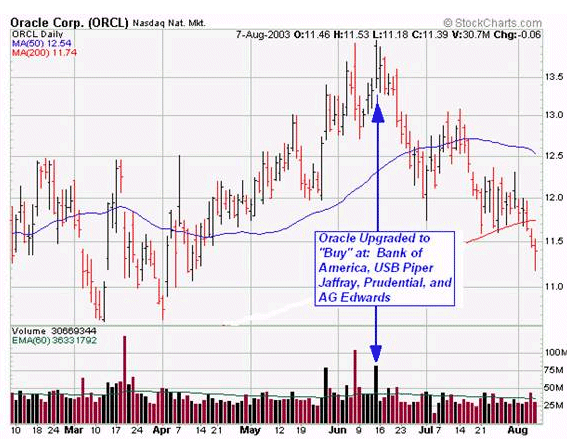
The recent chart below for Oracle Corp. (ORCL) is but one of many similar examples that are occurring day after day in today’s stock market. I used this chart because it is so blatant and obvious. (Also, see my article on the department store sector for another typical example for an ill-timed and suspect analyst upgrade.) It appears that the entire “Pool” upgraded Oracle to “BUY” on June 13th, 2003. Take a careful look at the chart including the annotations in blue and subsequent stock action before reading the next two paragraphs from The Great Crash 1929 by Galbraith, (written in 1954):
“The nature of these operations varied somewhat but, in a typical operation, a number of traders pooled their resources to boom a particular stock. They appointed a pool manager, promised not to double-cross each other by private operations, and the pool manager then took a position in the stock which might also include shares contributed by the participants. This buying would increase prices and attract the interest of people watching the tape across the country. The interest of the latter would then be further stimulated by active selling and buying, all of which gave the impression that something was afloat. Tipsheets and market commentators would tell of exciting developments in the offing. If all went well, the public would come in to buy, and prices would rise on their own. The pool manager would then sell out, pay himself a percentage of the profits, and divide the rest with his investors.
While it lasted, there was never a more agreeable way of making money. The public at large sensed the attractiveness of these operations, and as the summer passed it came to be supposed that Wall Street was concerned with little else. This was an exaggeration, but it did not discourage public activity in the market. People did not believe they were being shorn. Nor were they. Both they and the pool operators were making money, only, that the latter were making more. In any case, the public reaction to inside operations was to hope that it might get some inside information on these operations and so get a cut in the profits that the great men like Cutten, Livermore, Raskob, and the rest were making.”
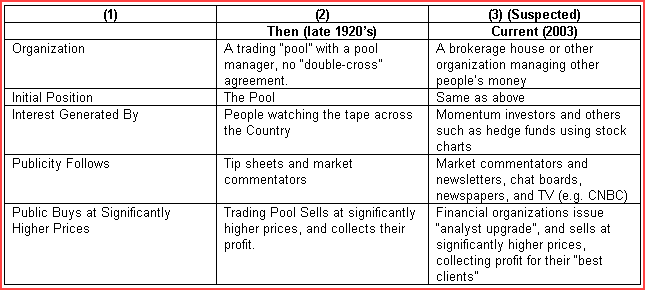
I am convinced that things are pretty much as they were in the time that Galbraith wrote about. I think the Table below appropriately compares “stock market operations” in the late 1920s to those of today:
There is no logical reason why a brokerage that is managing client’s money would issue an analyst “upgrade” that is publicized until well after they have taken their positions for their clients. In fact, if they were representing the best interests of their clients, it would be logical that they issue the upgrade at about the time that they wish to sell the shares in order to best promote a market for these shares. In spite of this obvious conflict of interest that would almost insure that the broker’s analysts issue upgrades and downgrades that run contrary to their actions, the public continues to buy stocks when a public announcement of a brokerage upgrade is issued, and sell them on downgrades.
The suspected activities I have outlined in Column 3 of the table above are not the subject of any official accusations beyond the barbershop, water cooler, or locker room. If they seem difficult to believe, consider whether you would have believed how widespread mutual fund illegal “late trading” was just 6 months ago. Indeed I have no substantive proof for Column 3, except for its simple logic. But I should also mention that the practices described by Galbraith (outlined in Column 2 of the Table) from the late 20’s were not widely known until after the 1929 stock market crash and subsequent government inquiries. Galbraith referenced Stock Exchange Practices, 1934, pp. 30 as his source of information. It may happen that the nuances of today’s operations to temporarily boom some stocks to the benefit of a few are not made public until the current market excesses are challenged as a result of a more recent devastating “crash”, and the inevitable investigations by the political and regulatory organizations. So far, there is no reason to investigate because every one is getting rich on paper.
However you cannot lay blame for the inevitable loss of public speculator wealth resulting from Column 3 activities (assuming they exist) entirely on the shoulders of the financial institutions and media outlets that are “booming” the stocks to the benefit of a few. Indeed it’s the small speculators who like sheep, are going willingly (again) for a shearing. While Wall Street is just being itself, the speculators are guilty of being naive of the timeless ways of Wall Street. In a better world the public would be warned. As Galbraith put it,
“The public would be warned sharply and often of the risks inherent in buying stocks for the rise. Those who persisted, nonetheless, would have no one to blame but themselves.”
Of course, as Galbraith states, these warnings would be expected but “It will not come to pass.”
So in sum we’re on our own. We need to study history and be more inquisitive and skeptical, while all the time suspecting that nothing has changed on Wall Street. Even though knowledge is a bit more difficult to acquire than simply turning on the TV, it is there for the taking, and well within reach of most investors. Books such as The Great Crash will help to provide you with the tools to hone these necessary critical skills. In the coming months and years, that is what will separate successful from failed investors.
O Clubeinvest.com informa que nenhuma da informação
aqui facultada deverá ser entendida como conselho ou recomendação
de qualquer tipo de transacção ou investimento.